Your payers aren't telling you about the revenue you're losing.
Every month, eligible members go unbilled and payer credits go unchallenged. Rendum applies Eligibility Intelligence across the entire eligibility-to-billing pipeline, so you capture every billable day and stop every false credit before it hits your bottom line. The same engine resolves Medicare Advantage supplemental benefits today, with Managed Medicaid and capitated roster reconciliation on the roadmap.
Centers for Medicare and Medicaid Services (CMS) supplemental benefit oversight is intensifying. Department of Justice (DOJ) and Office of Inspector General (OIG) enforcement is at record highs across both Medicare Advantage and Managed Medicaid. Spreadsheet billing will not survive a 2026 audit or a False Claims Act inquiry.
15–30%
avg revenue recovery
$110K+
avg annual capture
60-90 days
to go live
<2s
Audit chain produced
Shown: Medicare Advantage payer rosters. The same pipeline ingests Managed Medicaid Managed Care Organization rosters, Centers for Medicare and Medicaid Services Monthly Membership Reports, and capitated provider attribution lists.
Every eligible day, captured
Why every supplemental benefits vendor is silently losing six figures a year — and what Rendum does about it.
Rendum
from Latin reddendum · gerundive of reddere
In medieval contract law, the reddendum clause stated precisely what was owed.
Modern contracts still use the term — to render payment means to deliver what is due under a contract. Reddendum became render, and we shortened it to Rendum — same root, same obligation. Every billable day we calculate is a precise rendering of what is owed.
Three failure points. Every billing cycle.
The same root cause — eligibility data flowing through too many manual steps — creates three compounding problems that erode revenue and audit readiness simultaneously.
Too Many Moving Pieces
A single enrollment change has to flow through your billing system, your care management platform, and your operations team — in a different order for every payer, every month. Every extra handoff is another place the record falls out of sync.
Overbilling Gets Clawed Back. Underbilling Just Disappears.
When termination notices arrive late, you bill ineligible members and your payer issues a credit. But the opposite problem is silent: members who are eligible and should be billed — but aren't. Payers have no incentive to tell you. Eligibility lag costs you on both sides of the ledger, and only one side ever gets flagged.
No Standardized Process Per Payer
Every payer, plan, and state program has different Service Level Agreement windows, termination codes, retroactive adjustment policies, and grace periods. Without these rules built into a system, your team invents a different process each month, and the audit trail shows it.
Where billing staff spend their time (weekly average)
Medicare Advantage is now the top enforcement priority for the Department of Justice (DOJ) and the Office of Inspector General (OIG) of the Department of Health and Human Services (HHS). Eligibility errors are exhibit A in every audit.
$7.5B in questionable MA payments identified in 2023
OIG found that missing or unsupported eligibility documentation drove billions in payment exposure across the program.
Source: HHS-OIG Report, October 2024
$2.68B in False Claims Act settlements in FY2023 alone
DOJ enforcement against MA parties is accelerating. Downstream vendors are not insulated from audit liability.
Source: DOJ Press Release, February 2024
Up to $1.9M per HIPAA violation category per year
Eligibility files contain PHI. Manual handling — spreadsheets, email attachments, shared drives — is an uncontrolled exposure.
Source: HHS OCR Civil Money Penalty Schedule
State Medicaid program integrity is the parallel exposure
State Medicaid Fraud Control Units and federal-state joint False Claims Act actions apply the same evidentiary standard to Managed Medicaid vendors. Eligibility documentation gaps trigger Medicaid Recovery Audit Contractor reviews and joint federal-state recoveries.
Source: Department of Health and Human Services Office of Inspector General, Semiannual Report to Congress

"Every month, we're reconciling Medicare Advantage eligibility across four systems and three teams, and there's no single playbook for who gets billed versus who gets terminated. Every payer has its own rules for grace periods, retroactive terminations, and billable-day calculations — and every change ripples through all of them. When we overbill, the clawback shows up next cycle. When we underbill, no one tells us. It just disappears."
We hear this every week. Rendum codifies every payer's rules, unifies every system into one source of truth, and makes sure no billable day — or false credit — slips through.
Four steps. One audit chain.
Rendum replaces the chain of billing entries, care platform updates, and payer reconciliations with a single automated pipeline. One source of truth for every payer, every program, every system of record.
Ingest
Rendum collects enrollment rosters and eligibility files from every payer automatically — SFTP, REST API, or email. CSV, Excel, EDI, PDF. One intake point. No manual downloads.
Normalize
Every payer sends data differently. Instead of your team learning a separate process for each one, Rendum maps all formats into a single canonical schema — configured once, applied forever.
Rendumize
The Rendumizer applies your payer-specific billing rules — billable days, pro-ration, termination holds, retroactive adjustments — from reviewed, versioned rule sets. The same eligibility events always produce the same billable days. When a credit is questioned, the answer is in the log.
Output
One verified roster delivered to your billing system — every eligible member billed for what they are owed, every ineligible member held before a credit is generated. Rendum surfaces both sides. Payers will only tell you about one.

Capitated, roster-driven healthcare billing is a specialized domain.
Rendum is purpose-built for it.
No generic billing automation retrofitted for healthcare. Purpose-built for the eligibility file formats, payer contract structures, and audit requirements of Medicare Advantage, Managed Medicaid, and capitated provider arrangements. We started with Medicare Advantage supplemental benefit vendors because the eligibility complexity is hardest there. The same engine resolves the same problems across the adjacent programs.
See it in action
Every screen designed for healthcare eligibility operators who need speed, accuracy, and audit readiness.
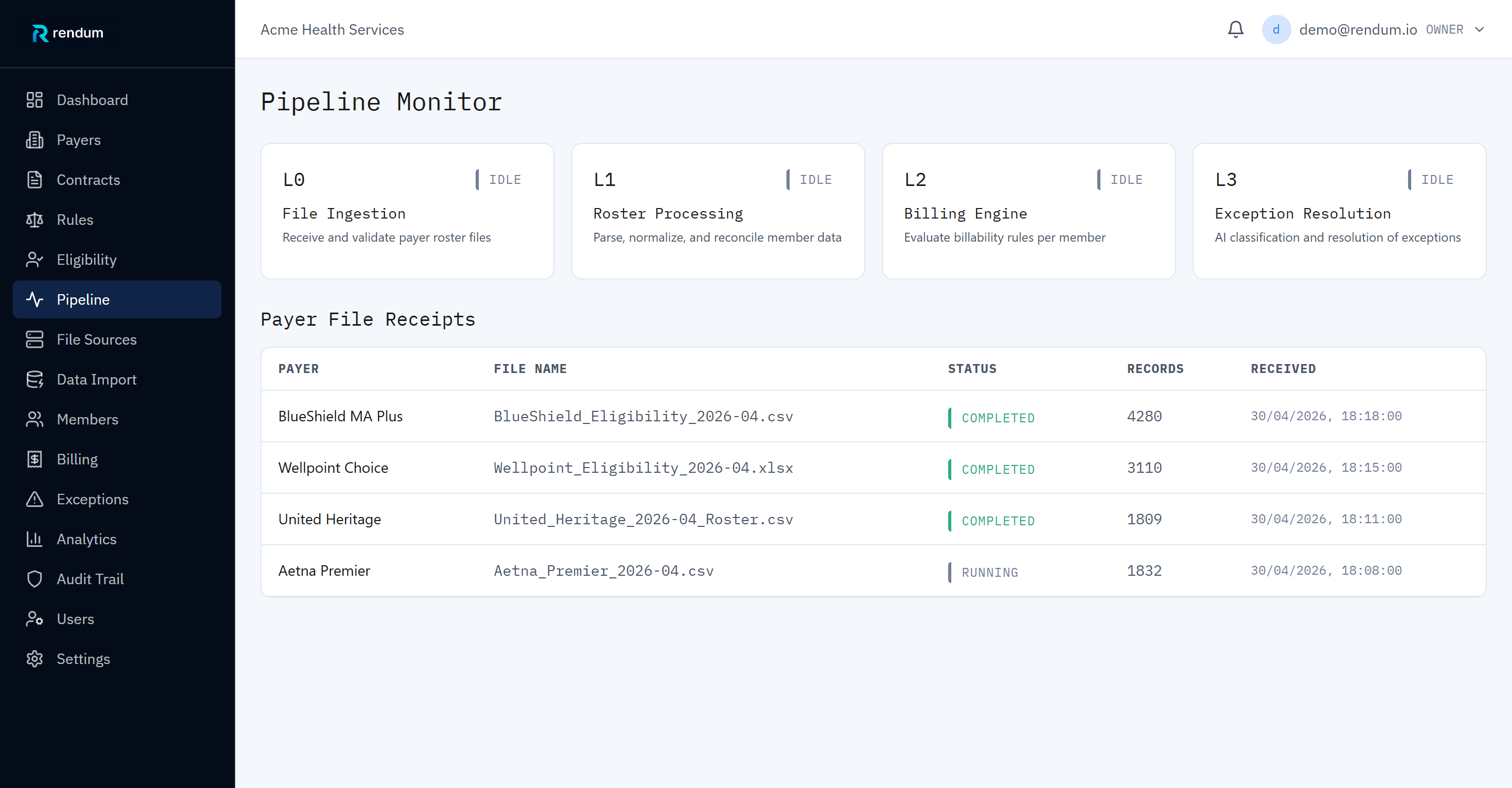
Pipeline Monitor
Watch eligibility files flow through the four pipeline layers in real-time. Every file, every record, every status change logged and visible.
- L0-L3 stage status at a glance
- Per-file ingestion receipts
- Record-level error tracking
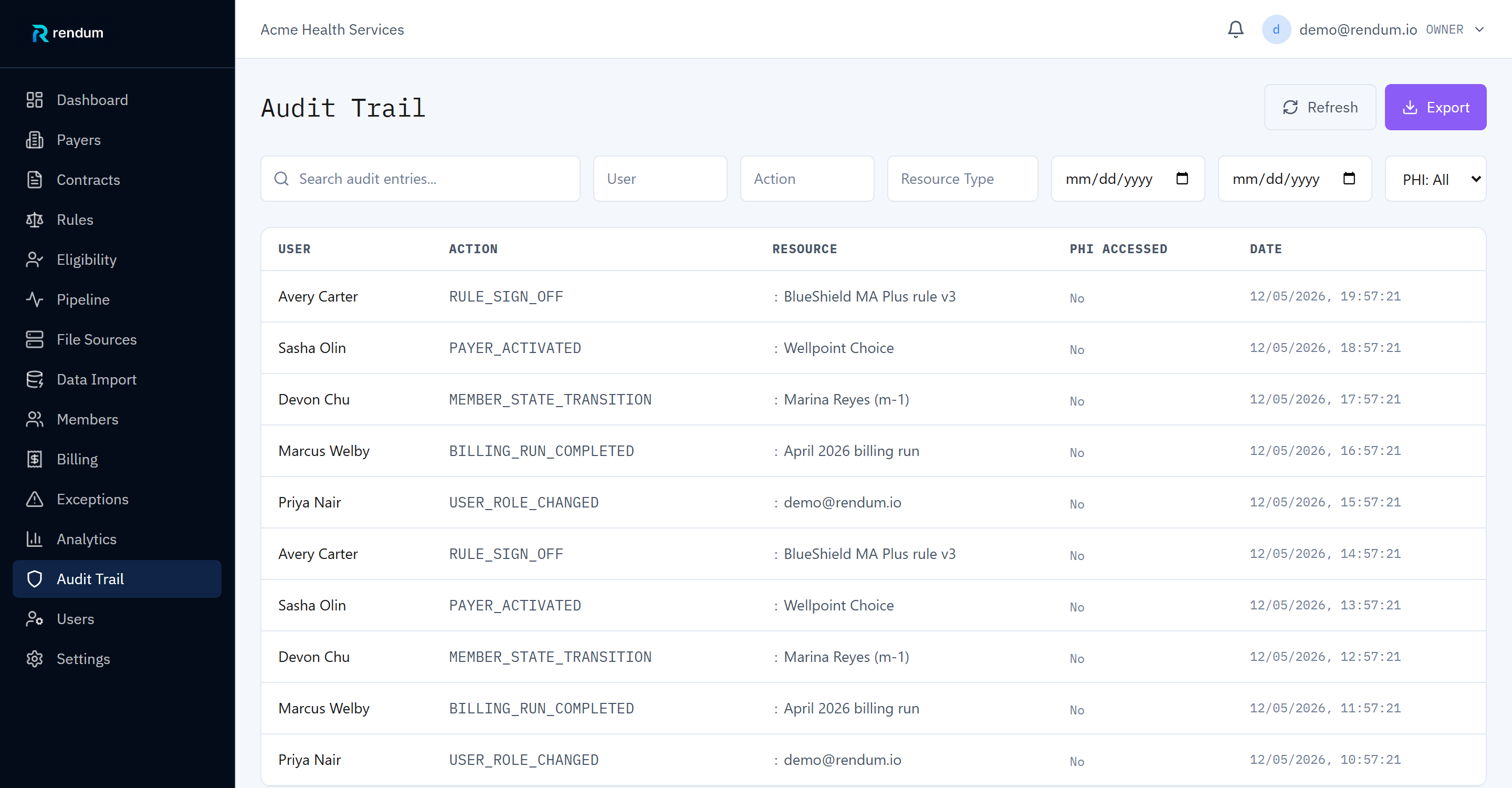
Audit Trail
Every action — rule sign-offs, payer activations, member state transitions, billing runs, role changes — captured with user, timestamp, and PHI access flag. HIPAA-ready out of the box.
- Immutable, queryable event log
- PHI access flagged per row
- Filter by user, action, or resource
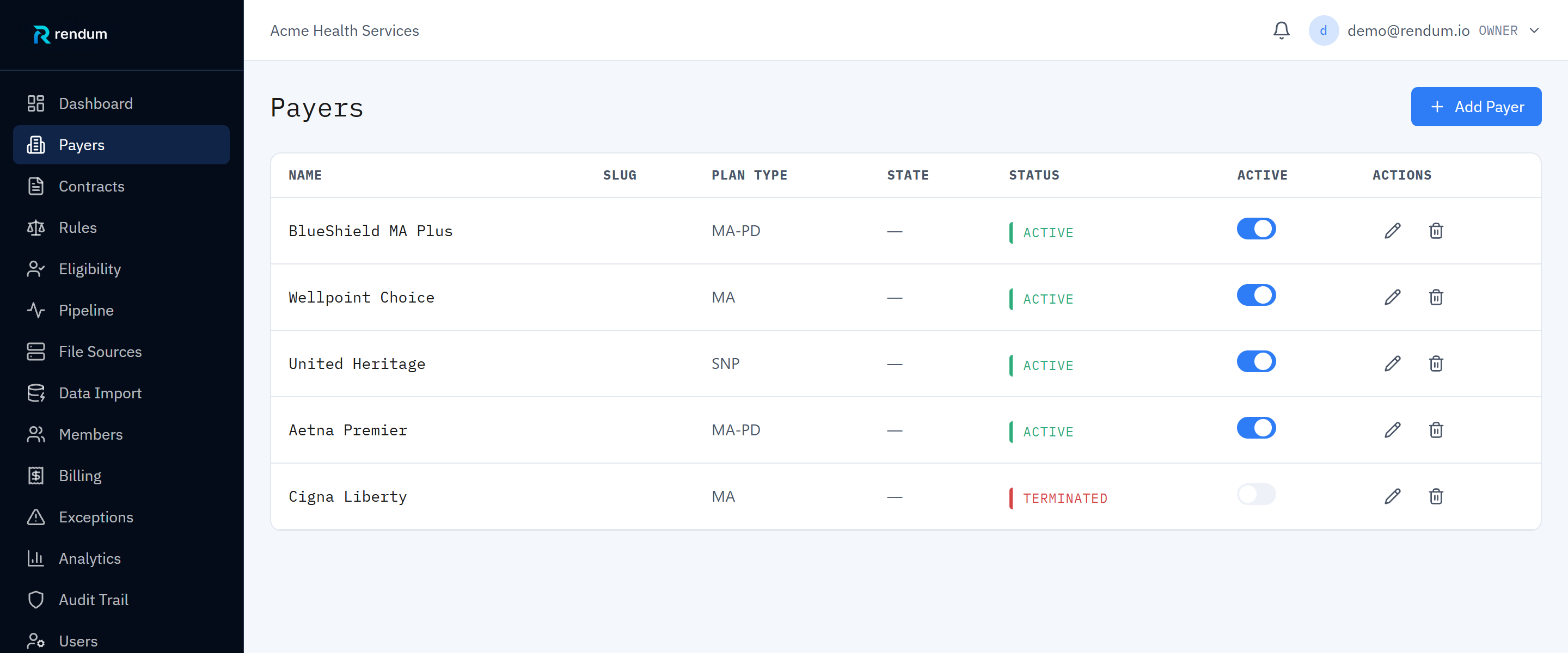
Payer Library
One screen for every payer contract you run eligibility against. Plan type, state, status, and activation toggle — all auditable, all versioned.
- MA, MA-PD, SNP plan types
- Active / terminated lifecycle
- Per-payer rule configuration
AI where it reads. Rules where it pays.
We use AI to do what AI is good at — extracting rules from payer contracts and normalizing files from every vendor format. We don't use AI to decide what gets billed, paid, or submitted to CMS. Every billing decision traces back to a specific contract clause, a named reviewer, and a versioned rule. The same input always produces the same output. When an auditor asks why a member was billed for these specific days, the answer is in the chain — not 'the model decided.'
Probabilistic systems applied to deterministic obligations
- ✕ Probabilistic decisions — the same input can produce different outputs on different runs
- ✕ "Reasoning logs" instead of clause-to-decision traceability
- ✕ Self-healing workflows that quietly change behavior between runs
- ✕ "95% accuracy" means 5% of your billable days are wrong, and you do not know which ones
- ✕ When the auditor asks why a member was billed for these specific days, the answer is "the model decided"
A pipeline that produces the same answer every time
- ✓ Deterministic execution — identical inputs always produce identical outputs
- ✓ Every billable day traces back to a versioned rule, a signed-off reviewer, and a specific contract clause
- ✓ AI used only for contract extraction and file normalization — never for billing decisions
- ✓ Mandatory human sign-off on every extracted rule before it goes live
- ✓ Audit chain producible in seconds: clause → rule → eligibility events → billing decision
Eligibility billing is a deterministic obligation: the contract says what's owed, and the same facts should always produce the same answer. AI is the right tool for reading contracts and parsing files. Reviewed rules are the right tool for deciding what gets billed.
The deterministic, clause-to-decision audit chain is what False Claims Act defense requires. It is also what state Medicaid program integrity reviews require, what Centers for Medicare and Medicaid Services Recovery Audit Contractors require, and what your payer counterparties require when a credit is disputed.
Reviewed rules by design
AI extracts rules from payer contracts and normalizes vendor files. The Rendumizer applies reviewed, versioned rules to those normalized inputs — full trace from contract clause to billable day.
AI extracts rules from payer contracts and normalizes vendor files. The Rendumizer applies reviewed, versioned rules to those normalized inputs — the same eligibility events always produce the same billable days. Whether the rule source is a private payer contract, a Centers for Medicare and Medicaid Services regulation, or a state Medicaid managed care contract, every decision traces back to a specific clause, a named reviewer, and the rule version that was active at the time.
Ingestion
Normalization
Rendumizer
ReviewedOutput
Built for regulated healthcare
Rendum is designed from the ground up for HIPAA compliance and SOC 2 Type II audit readiness.
HIPAA Compliant
Full 45 CFR compliance with BAA support for every customer.
SOC 2 Type II
Pursuing independent audit of security, availability, and confidentiality controls.
AES-256 Encryption
Data encrypted at rest and in transit. Zero plaintext PHI storage.
Azure Government
Deployed on FedRAMP-authorized Azure infrastructure.
Before and after Rendum
Before
After Rendum
Stop missing billable days.
Get a 30-minute demo with your own data. See your projected recovery before you commit.